Starbucks Corrective Action Policy: Write-Ups & Warnings Explained
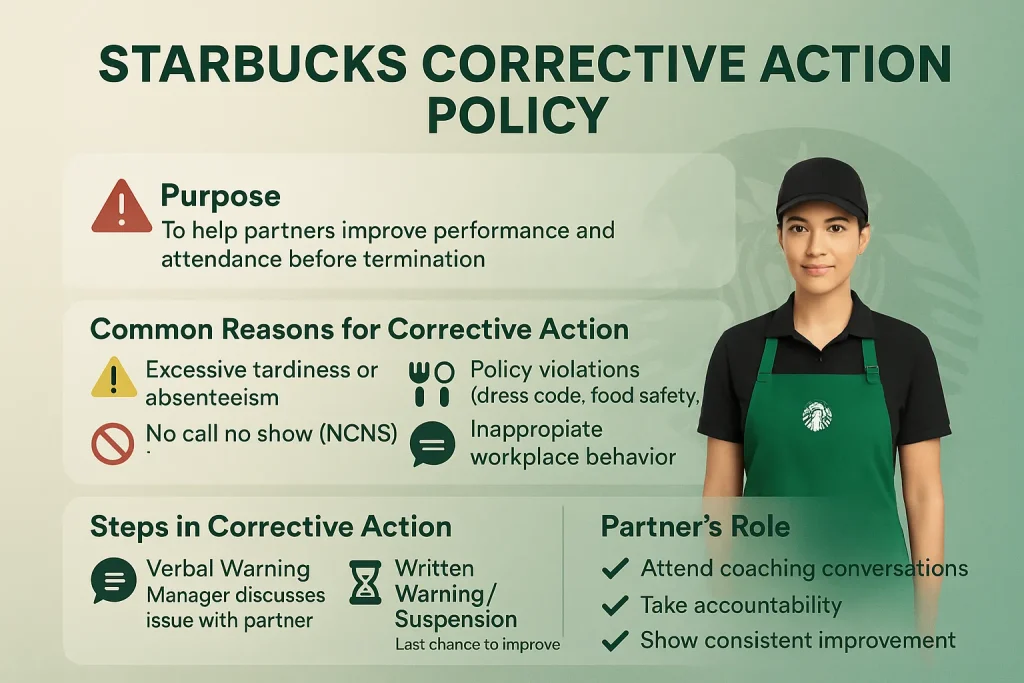
The Starbucks corrective action policy is a step-by-step system used to deal with problems at work. It helps partners understand when something is wrong and gives them a fair chance to fix it.This policy applies to all partners, from baristas to shift supervisors. It’s used for things like being late too often, missing shifts, breaking store rules, or not following company policies.
The goal is not to punish you, but to coach you and correct the issue. You’re given clear feedback, and the chance to improve before things get more serious.
There are four main steps in the process (which we’ll explain next):
- Verbal coaching
- Written warning
- Final written warning
- Termination
The Four Stages of Progressive Discipline at Starbucks
Starbucks uses a progressive discipline system. That means you’re given chances to improve before more serious action is taken. Here’s how each stage works:
1. Verbal Coaching (First Step)
This is a friendly but serious conversation with your manager.
- It’s usually not written down in your file—just a warning.
- Your manager will explain what went wrong and what needs to change.
- You’re expected to improve right away.
Example: You’re late twice in a week. Your manager pulls you aside and reminds you about the Starbucks attendance policy.
2. Written Warning
If the issue continues, you’ll get a written warning.
- This goes into your employee file.
- You may be asked to sign it (this doesn’t mean you agree just that you’ve seen it).
- Your manager will review expectations again and tell you what happens if it continues.
Example: You were already verbally coached for lateness, but now you’re late again. You receive a Starbucks write-up.
3. Final Written Warning
This is the last step before termination.
- It’s very serious—you’re told clearly that another issue may result in dismissal.
- You’ll be watched more closely during this time.
- This step stays on your record and may impact transfers or promotions.
Example: You called out without notice after already being written up. Now you’re on a final warning under the Starbucks corrective action policy.
4. Termination
If the behavior continues after a final warning or if the issue is severe you may be let go.
- You may be removed from the schedule immediately.
- Your manager will inform you and explain the reason.
- Depending on the situation, you may be marked ineligible for rehire.
Common Reasons for Write-Ups at Starbucks
Starbucks uses the corrective action policy to handle all types of issues. Some problems are small and start with coaching, while others can lead to immediate write-ups. Here are the most common reasons partners get written up:
Attendance Violations
This includes:
- Showing up late often (violating the Starbucks late policy)
- Missing shifts without calling (no call no show)
- Calling out too frequently without enough sick time
- Not logging sick time properly
Even small issues like forgetting to clock in or not communicating early can count as an attendance violation.
Behavior or Policy Violations
This can include:
- Being disrespectful to coworkers or customers
- Ignoring health and safety procedures
- Arguing with management or refusing a task
- Breaking store policies (like dress code or phone use)
- These usually start with verbal coaching, but if the behavior continues, it can move quickly to a written or final warning.
Performance Issues
Sometimes partners are written up for:
- Not making drinks correctly
- Working too slowly during rushes
- Not following routines or cleaning tasks
- Repeated customer complaints
If your manager sees a pattern, they may start the progressive discipline steps to help you improve.Each store handles these things slightly differently, but all follow the same Starbucks write-up policy and corrective action process.
How Long Do Warnings Stay Active?
If you’ve received a write-up, you might wonder: how long does it stay on your record? The answer depends on your behavior after the warning and how your store handles documentation.
Timeline Between Steps
- There’s no fixed number of days for how long a warning stays active.
- In most stores, warnings stay on file for 30 to 60 days, depending on how serious the issue was.
- If you go that long without any more problems, the warning may not affect you moving forward.
- But if another issue happens during that time, Starbucks may move you to the next step in the corrective action policy.
Can Your Record Be Cleared?
Starbucks doesn’t “erase” warnings automatically, but:
- Managers may stop counting old write-ups if you’ve improved
- If a long time passes without issues, you can be considered “in good standing” again
- You can ask your manager to review your file if you’re unsure what’s active
Important Tip
Even if a past write-up seems inactive, it might still be used in decisions about:
- Promotions
- Transfers
- Rehire eligibility (if you leave and reapply)
So while time can help, consistent improvement matters most.
Appealing a Write-Up or Final Warning
If you believe a warning was unfair, you have the right to speak up. Starbucks allows partners to appeal write-ups and final warnings through store leadership or Partner Resources (HR).
Your Options
- Talk to your manager first – Stay calm, explain your side, and ask if the write-up can be reviewed
- Use Partner Hub or contact Partner Resources – You can request a review or file a formal complaint if needed
- Bring evidence if you have it – Call logs, schedules, or witness accounts help support your appeal
Starbucks encourages fairness, but you must act quickly—especially after a final written warning. Waiting too long may limit your options.
Real Partner Experiences with Corrective Action
“I was written up for being late, but I had called and explained I was stuck in traffic. My manager didn’t listen—Partner Resources helped me get it removed.”
– Partner, Seattle
“I had two warnings already, and after a no-call, no-show, I was terminated. It felt harsh, but I was warned.”
– Shift Lead, Miami
Partners across stores report mixed experiences. Some say managers follow the progressive discipline policy closely, others say write-ups are used too quickly. This is why it’s important to:
- Ask questions
- Document everything
- Know your rights as a partner
FAQs About Starbucks Corrective Action Policy
1. How many write-ups before termination at Starbucks?
There’s no fixed number, but typically: verbal → written → final → termination. In serious cases, steps can be skipped.
2. Can I be fired after one write-up?
Not usually. But if the issue is severe (like harassment or theft), Starbucks may go straight to termination.
3. Do write-ups expire?
They don’t officially “expire,” but if you go 30–60 days without issues, managers may stop counting them against you.
4. Can I transfer stores if I’m on a final warning?
Possibly, but it may require manager approval and a clean record for some time first.
5. What if I never signed the write-up?
Signing only means you received it—not that you agree. You can still appeal through Partner Hub.
Conclusion: Know the Process, Protect Your Position
The Starbucks corrective action policy is built to give partners a fair chance to fix mistakes. But it’s also serious ignoring warnings or repeating issues can lead to losing your job.
The best thing you can do? Communicate early, take feedback seriously, and document everything. When you understand the system, you can stay in control of your future at Starbucks.